We found her 14 years ago under the deck of our house in Aurora, the far-west suburb of Chicago where we used to live. Ted recalls that it was our then-college-student daughter, Megan, who heard the little “mew”s, but she thinks it was him.
Either way, the kitten couldn’t resist the bowls of milk that Ted kept placing on the grass next to her hideout. She had to take a few tentative steps outside, then a few more.
He was finally able to pick her up, and we managed to get her into the car and off to our veterinarian a few blocks away. The gentle (aren’t they all?) doctor told us he suspected she was feral—until she began purring as he stroked her fur.
That is how Olive came to join our little family. Megan named her immediately, as she had Olive’s two big sisters, Clarice and Cupcake.
Although Olive immediately assumed the submissive role, sibling rivalry soon reared its furry head. For Clarice, though, it was more sibling indifference and for Cuppy it became a sort of mentor relationship but with lots of swatting.
Megan told us the name of the new kitty was a homonym for “I Love,” and she later created a painting of an olive with the phrase “Olive you” (an old daddy/daughter signoff), which now hangs in our kitchen.
Shortly after Olive’s arrival, it was time for Megan’s departure. She was a sophomore at Illinois State, in addition to being a gymnast and a cat owner herself. (The topic of Frank and his seeming dislike of Ted has been discussed elsewhere, so I’ll just add this: Megan and her now-husband Phil still let Frank have his own room in their Chicago apartment.)
Another change: We began calling our new cat LaLa instead of Olive. Not sure how that came about, and Megan still refers to her by her original name.
Fast-forward about a decade—through Megan’s graduation and her move to the city and, sadly, the deaths of Clarice and later my beloved Cupcake—we sold our home and moved to Evanston.
LaLa was “queen of the castle,” I’d always tell her. Whenever Ted worked from home, she sat in the den on her perch next to him, “supervising.” Each time I left the condo, I’d be sure to remind her, “You’re in charge.”
She was a happy, playful cat who liked to sit outside on the deck when it was warm. Sometimes, late at night with just Ted, she became Adventure Girl, venturing down the hallway.
She went on long road trips with us, exploring the exciting terrain that was Grandpa’s house in Indiana or hanging out in pet-friendly hotels. When Ted’s father joined us for a spring training baseball trip in Florida, LaLa was a familiar friend near the end of his life.
Earlier this year, LaLa was diagnosed with cancer. Surgery was rough on her, but she eventually got some of her spirit back. But it wasn’t long before Ted felt a small lump in her belly. We didn’t want to put her through more suffering, and the vet told us it would likely be a short time before she simply didn’t wake up, having died without pain.
We dedicated ourselves to helping LaLa “live her best life” for as long as she was with us. Only Fancy Feast pâtés would do, even if she changed flavor preferences by the day. We tried to keep things quiet and calm, with lots of cuddling—but only when she wanted it.
We were fortunate to be good friends with a cat-loving couple down the hall. Since LaLa no longer seemed up for road trips by October, they cared for our girl while we made abbeviated trips to Minnesota—one to see Paul McCartney in concert and the other to the Mayo Clinic, for me.
LaLa was still cuddly and purry last month, but she wasn’t eating as much and appeared to struggle to find comfortable positions.
Then, one day last week, Ted woke me up to tell me she hadn’t come into the bedroom meowing for him and that she was still “soccer-balling” on her perch. Still breathing, but …
In the end we said our goodbyes at our new veterinarian’s office. We stroked her fur as she soccer-balled on a towel in the examining room. We both cried as I sang her favorite Beatles song.
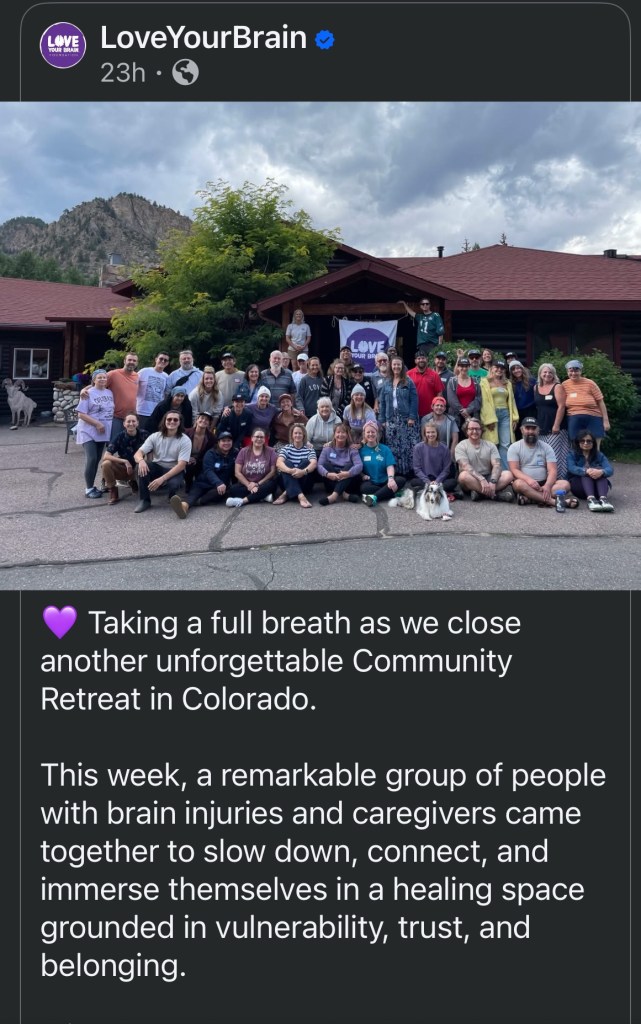
I spent the past week in Empire, Colo., on a Love Your Brain Retreat for folks like me. That’s right, there are folks like me. What a revelation!
Before the trip, I imagined I would seem like some kind of fraud (never mind my ridiculously complicated drug regimen, my enormous sleep needs and my goofy behavior). I figured I’d look like some kind of “normie” TBI poser next to my fellow campers, who surely hadn’t learned to cope as well as I had.
Turns out, I had a lot to learn.
My more than 40 newfound friends hail from a melting pot of states, including Massachusetts, Connecticut, New York, New Jersey, Maine, Pennsylvania, Ohio, Indiana(!), Michigan, Minnesota, Montana, Oregon, Colorado, California (I think), North Carolina, South Carolina and Georgia. I was the lone Illinois representative, and there was also one Canadian, from Toronto.
Their brains had been damaged by car crashes (like me), falls, strokes, motorcycle accidents, multiple sports-related concussions and, in at least one case, a serious illness.
Their ages, from what I could tell, varied from approximately mine (middle age-ish) to retirees to careerists to–and this truly broke my heart–young people who hadn’t had the chance to experience what I had, at 41, when my accident happened.
Good grief! I’ve been typing this long and I haven’t mentioned the Rockies! When I’m finished writing, I’ll get my husband to help me insert a couple of the too-many photos I took of the scenery. For the first two days, I kid you not, every time I stepped out of a cabin door I couldn’t help but look out and say, “Oh, my God!”
Anyhoo, in the circle, other campers echoed my concerns about not being taken seriously, because brain injury is an “invisible” illness. No matter how distant or recent their diagnoses, the common theme was what a relief it was to be with others who understand. We may look like everything’s hunky-dory, but there are a lot of intricate pieces holding everything together. Sleep. Drugs. Routine.
The retreat provided it all, and then some. The medical staff made sure we got our daily meds at the proper times, even if they had to hunt some of us down when we forgot. (Guilty!) Mealtimes (brain-healthy portions created by our neurologist-turned-chef-after-a-TBI) were at 8 am, noon and 6 pm sharp), plus unlimited healthy snacks, plus the protein bars I had stashed in my room. (A girl’s gotta eat!)
We had optional blocks of activities during the day, interspersed with two-hour periods of rest or free time. Those who know me can guess I didn’t want to “waste” a moment recharging my brain. I explored the area, talked with everyone I could find (name tags helped us all) and even played the piano(!).
The mountains themselves provided my greatest adventures. We were allowed walk alone but were required to have a running buddy on the steep slopes. My running buddy was a young man who became a runner after multiple concussions had sidelined him from hockey. Taking the safer wood-planked uphill path, we ran (jogged? I’d left my running watch behind, because who cares?) up and up, occasionally, getting a perpendicular break before heading upward again.
Exhilaration! Sure, I huffed and puffed, but my quadriceps muscles were giving me a hallelujah in comparison to my usual flatland training. When we turned to go down, I was in hamstring heaven–though, of course being careful with my steps. We ended up in a different place, so it was up again and down again (the brain injured leading the brain injured)!
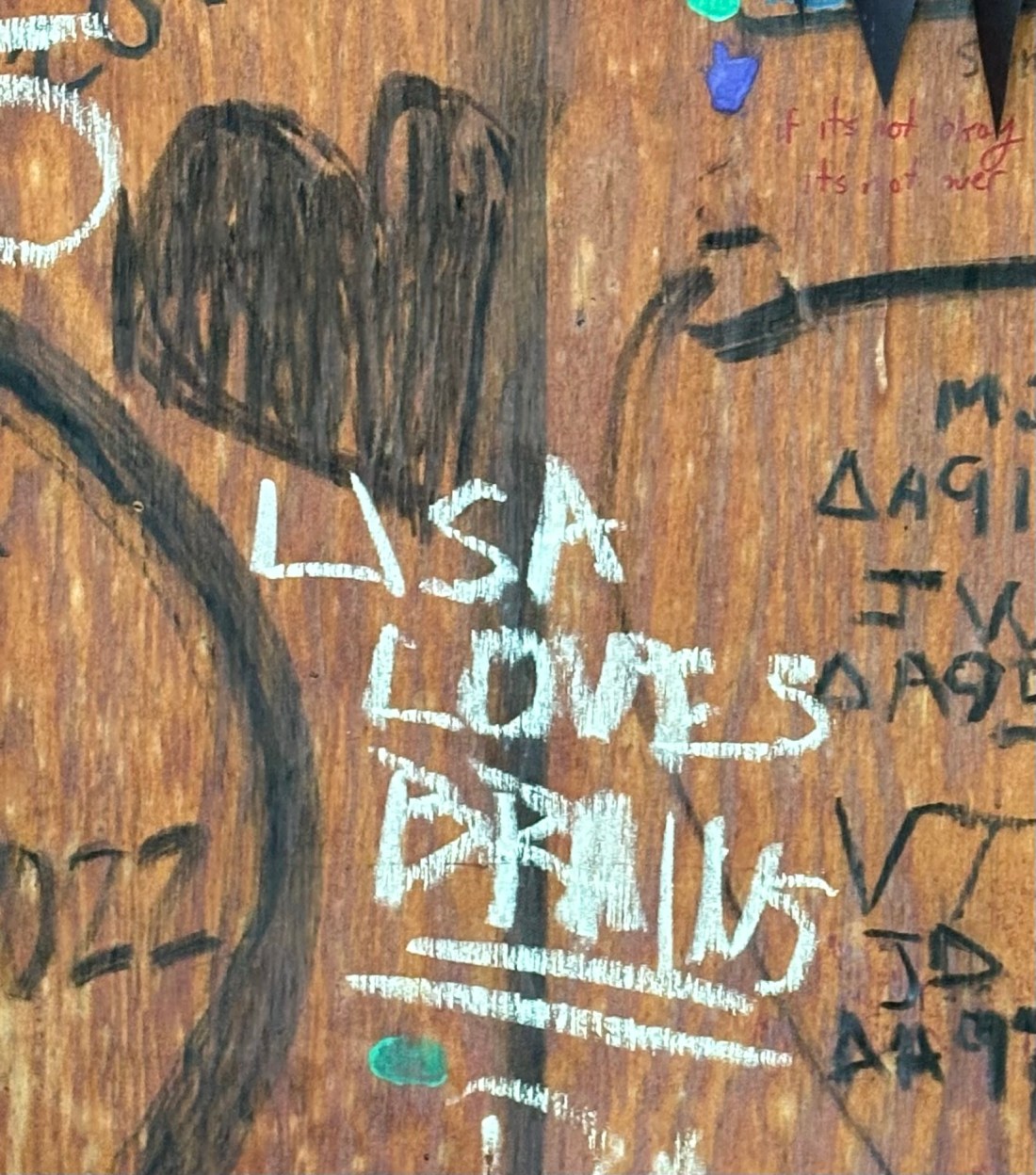
Other days there were hikes, alone or with various groups. With two friends, I hiked quite a bit higher than I’d run with my buddy. One guy showed me a ramshackle cabin at a low summit. I can’t remember its original use, but various groups that have stayed at the retreat grounds have covered the interior with hilarious graffiti. I picked up a piece of chalk and added “LISA LIKES BRAINS.” If later campers think I’m a zombie, so be it.
I walked down alone and encountered a retired gentleman who was part of what I’ve come to call The Breakfast Club. This consists of myself and two retired couples–both with the wives as caretakers. I’d eat breakfast with them sometimes and came to see them as parental figures–especially the bearded Bostonian who called me “kid.”
The man on the trail seemed a lot like me–happy, silly, rebellious at his spouse’s attempts to keep him safe. Also, an adorable giggle (post-TBI). He wanted to get off the boardwalk and onto the more dangerous slope, so I made sure to protect him. (I should note here that staffers were always nearby.) We sat on a stump and talked. The gist: He’d been a corporate-type guy who was always stressed about this and that. After his brain injury, he’s a new man. Oh, and did I mention he walks with a staff carved with the face of Gandalf from “Lord of the Rings”?
Next was art therapy, where the idea was we often mask what’s really going on.
We all paired off, and one of us lay down while the other applied plaster-coated strips to our face, minus the eyes, nostrils and mouth, of course. Anyone uncomfortable with such intimacy could choose a ready-made mask. My partner, a former gymnastics school owner from Maine, eased my art anxiety as she talked about the sport with me, the mother of a former college gymnast.
Then it was time to decorate the thing. Oy.
I really had no idea what to do when I sat the table with two fellow campers and a staffer, who was also creating a mask. When I said as much, I got advice. Lots of advice. A head-spinning amount of advice for someone as easily overwhelmed as I am. One of these new friends, a soft-spoken, wise and caring man, talked with me about myself.
Somehow, with all of their counsel, along with practical help from the staffer, I began to make “art” out of the vision I’d articulated: “My mask is humor. I use wit and silliness to cover up tension, even sadness.” I forgot to take a photo of my mask–no way was I lugging it back on the plane–but it ended up with Krusy the Clown style hair made of glue-gunned feathers and a clown nose I made by hot-glueing a fluffy ball of some sort that I’d rolled in red paint. I found a silver sequin tear, so I put that on, too. Sad clown, I guess.
The other main activity was yoga–a couple of daytime sessions of gentle yoga and also yoga nidra at night, right before bed. Before this retreat, I figured all this yoga stuff would be soooooo unnecessary for me. I’m a trained yoga teacher … well, technically. I’ve volunteered as a teacher, but that was I-forget-how-many years ago. These days I just like doing yoga, learning new stuff. Selfish, now that I think about it.
And for the uninitiated, yoga nidra is a soothing, almost still practice done on the back. It’s not uncommon for people to fall asleep. There were lots of snores. Sometimes, buried emotions come up, and that’s what happened to me. With all the physical and mental “trying” pared away, I think I opened a door to some real feelings. Spoiler alert: Brain injury is hard. Anyway, a very gentle staffer was there to talk me through it.
I know I’ve already mentioned the food (See how I’m avoiding unpleasantness?), but a very interesting practice we did on two mornings, silent breakfast, deserves mention. The idea is to eliminate the distraction of conversation, which by that point in a week when you got to know so many people who understand and accept you as you are, is impossible. We. Had. Pancakes.
With butter. And syrup.
For me, closing my eyes and enjoying my food ever-so-slowly was a natural. We shared our experiences–some had looked around, some out at the mountains. One woman tried to make eye contact with people until they turned away. But another woman said she spent the whole time just watching me enjoy my food.
I don’t know if that’s called being in the moment or just being hungry!
The last night of the retreat was our talent show. It was a surprising, amazing, moving, hilarious night that displayed the many ways people living with brain injury still have–or come to develop–expertise. There was music, poetry, dance, art, comedy–all shepherded by a couple of wackily dressed MCs from the staff, one of whom had a literal hook for when someone went over their time.
I went over my time. I was reading one of my blog posts, *”Idiot-proof watch, meet idiot *Is not the title of this blog post,” when I got a poke at one of the laugh lines. My reaction? No ego. I doubled over in laughter as I exited stage-left.
The next morning, it was a frenzy of packing (we’d already started the day before), a quickie breakfast and tearful goodbyes before the airline travelers boarded the shuttle for our trips home.
This trip was a big deal.
So many wonderful people–and a therapy dog from South Carolina I’m in love with. It took me a couple of days of grieving, and I’m still wearing my Love Your Brain ballcap, but now I’m really back. I’ll be staying in touch with my new friends.
First off, getting there and back meant flying, and since I had impulsively decided against having my caregiver/husband along, it meant flying all by myself. Not only had I not flown solo since the 2008 car accident, I’m pretty sure this was the first time in our 30-plus-year marriage I had done that sort of adulting.
Luckily (or is there really such a thing as luck?), my super-protective and hyper-competent husband got things prearranged for me on the front end. As for the return trip, I was in the hands of my new heroes, a saintly husband-and-wife duo who call themselves the A Team. Later, at my departure gate, another angelic fellow camper helped me on my way.
Truly, traveling was the only difficult part of the week. The rest was bliss.
As anyone who knows me knows, I’ve got a traumatic brain injury. My accident was almost 16 years ago, so it’s old enough to drive but too young to vote. (At this time, I’d like to apologize both for pointing out my TBI, which I do constantly—mostly because I can’t remember who I’ve told—and also for that lame joke.)
Making light of my weirdness has been one of the coping strategies I hope to share in August at a five-day retreat in Denver for people like me. I’ve got a lot to learn, too. Maybe hearing the stories of my camp mates will help me drop the facade and share my real challenges.
You see, every brain injury is different. Some people, like me, end up with epilepsy and are put on a series of seizure-controlling drugs. Others suffer painful headaches. Many of us are sensitive to loud noises and artificial light. And multitasking? Forget about it.
That’s where the LoveYourBrain Foundation comes in. Since 2014, the organization has been offering TBI survivors worldwide the chance to gather for companionship, gentle yoga, counseling, art and nature activities, and plenty of quiet time.
The best part is its pay-it-forward approach to tuition. Not everyone is as fortunate as I am, so the foundation allows patients to attend free of charge (minus airfare) but encourages fundraising efforts.
That’s why I’m passing the virtual hat for this wonderful organization. Any amount would help those in need.
One more thing before I sign off: Caregivers are invited too, but I impulsively decided to go solo. This is a major step for me. My husband has taken care of EVERY aspect of my care all these years, so much so that I sometimes rebel like a child.
I’ve never been to Colorado. I can’t remember the last time I’ve taken a flight by myself and—holy cow, am I ever the definition of high-maintenance. This trip is either going to broaden my horizons or narrow my expectations. We’ll see.
Have you ever misplaced something—something like, say, your keys—and then had to retrace your steps? Sure, you have. Everyone does that. No need to use brain injury as an excuse.
A few evenings ago I’d taken my keys with me when my husband and I went out. Didn’t give those keys a thought until next morning, when I was in my usual rush to an appointment. (You didn’t ask, but that appointment was a dance class at the Y. What I lack in grace I make up for in enthusiasm.)
I used a spare key to lock up, putting off the search until later.
Much later, well after Second Breakfast, tidying up and español lessons on Duolingo, I checked the usual places where stuff turns up—counters, bathrooms, etc.
Then I panicked. Surely the keys had fallen during last night’s group run. … No, wait: Maybe they were still in my running belt, which I’d tossed into the laundry.
But no. So began the retracing. This took the form of a slow jog, easy on the body but tough on the mind.
I kept looking down, reminding myself to check park benches and the bases of lampposts, where people often place objects they find along the path.
When my running watch pinged, telling me I’d gone 1 mile from where the GPS function had kicked in, I knew I was about to reach my turnaround point from the night before, so I trotted on.
Then my brain pinged. I stopped running and started laughing at myself.
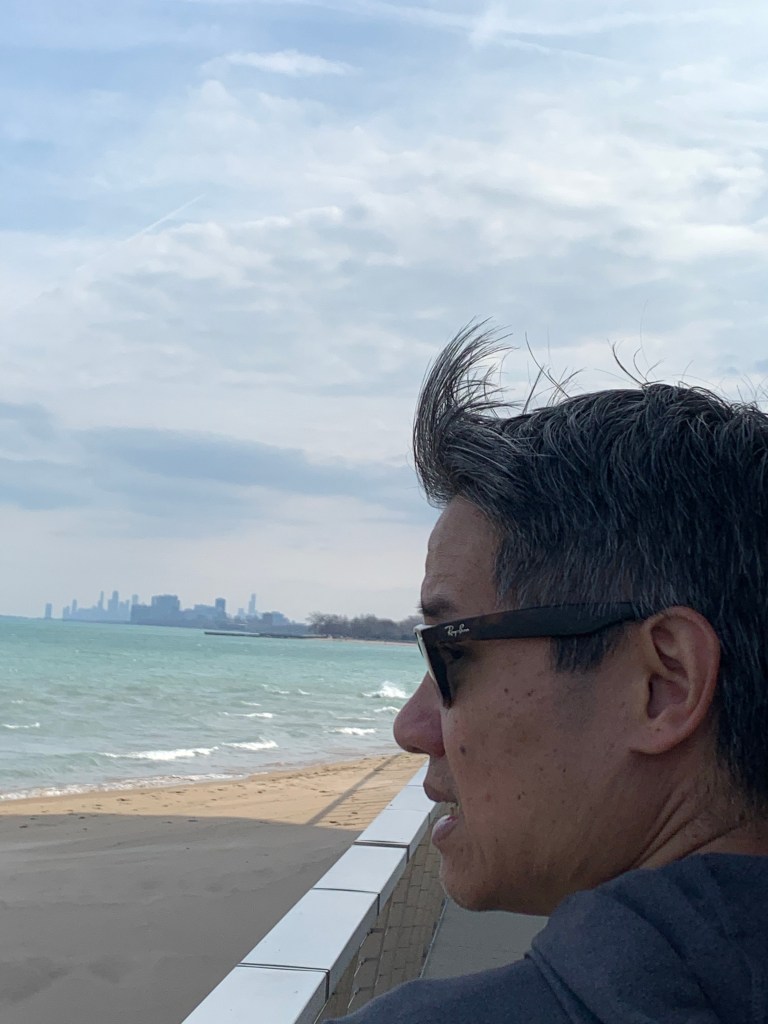
Along with the familiar view of Chicago, I recalled the sensation of having my jacket tied around my waist and the feeling of annoyance at having to readjust it as something kept whacking me in the gut.
My keys! Which I now saw myself zipping into the pocket—the pocket of last night’s jacket, now sitting in the dryer.
During a walk yesterday with my friends Helen and her assistant, we turned a corner we don’t usually turn. I was paying attention to nothing more than the trees and houses to our left, when Helen, looking at flora to the right of the sidewalk, spotted him. The elderly man had apparently fallen next to the sidewalk.
He was conscious but disoriented and was able to give us his name. He said he was on his way back to the memory-care center across the deserted street. (Helen’s a resident of the active-senior facility across the next street, and her helper works there.)
We did our best to soothe him as we waited for a staffer and then medics to arrive. He was anxious to get back to his building, telling me it was time for lunch.
Back at Helen’s building, my friends noticed I had been crying. I said it was because the man had looked a little like my father, but I don’t think that was it.
Our lives are fragile. Our minds are fragile.
I guess the moral of the story is this: Always take the unexpected turn.
Haha! Lisa inquired about her lost sunglasses, only to be told they were on her head (“Sweetie …,” said the desk clerk with a wry smile.)
Whoopie! I often say the first thing that comes into my head. (“I’ve got perfect vision!” I announced to my daughter and her boyfriend from behind a pair prescription specs.)
Heck, it’s my nature to make light of everything. Hence, my blog.
Last night, though, I had a scary lapse, one that I hope is not a harbinger of things to come.
I was getting ready for bed, and my mind was wandering. A name came to my consciousness. For a few moments, I had to mentally ask myself, “Ted … Who is Ted?”
Ted is my husband of 30 years.
Lest I forget
I went to him in tears, telling him about the incident and asking if we should call the neurologist. He was calm and reassuring.
I had recently had many disruptions to my all-important routine. We’d recently visited relatives and later ate dinner in the city (both pandemic firsts). I ran a 5K last month and just started swimming lessons.
I have excellent neurological care, never miss a dose of drugs and do everything I can to promote my physical, intellectual and mental health.
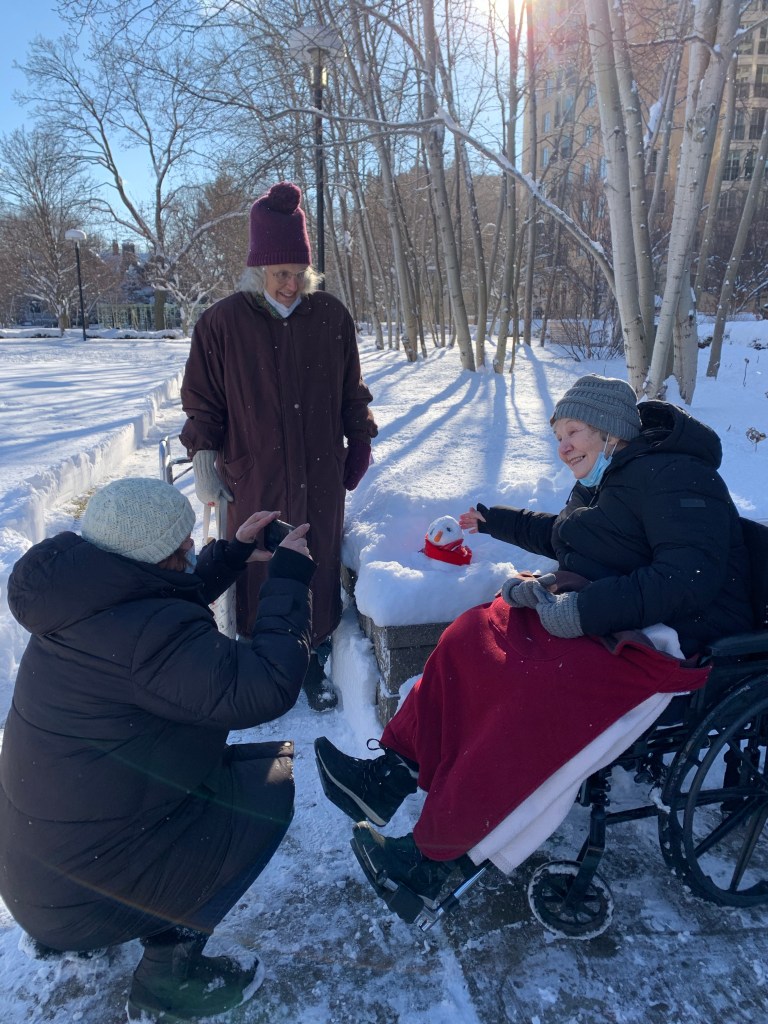
Meet Peekaboo, the little snowman expertly crafted by nursing aide Barbara (taking photo in pic) out of powdery snow.
My friend Helen and I were walking in the garden at her senior residence, The Mather, when we met Barbara and her charge, Trudy, as Barbara was starting construction.
Barbara snaps a shot of Peekaboo and Trudy as Helen looks on.
I tried to help but couldn’t get the snow to stick. “I’m from Poland,” Barbara said, explaining her skill with snowcraft and promising to build a full-size snowman when conditions are right.
Trudy, who lives in the memory-care, section of The Mather, was delighted, especially as someone from the Deep South who never got to play in the snow.
We all had a great conversation, though Trudy and I kept having to be reminded of each other’s names.
Afterward, Barbara mentioned that the day had provided a great activity for Trudy.
For this not-yet-senior, who increasingly struggles with names and longs to meet more people in her new city, it was a great activity for me, too.
This morning I woke up determined to turn over a new leaf and get chores and exercise out of the way early.
I’d loaded the dishwasher and washing machine and was about to head out when I checked Facebook and saw one of those “daily gratitude” posts that people do this time of year. Normally I ignore those, but today I was fresh off a morning meditation session and let my friend know I appreciate and share her sentiment.
Sweet.
Then I left the building with my grocery list and credit card in my backpack … and that’s when things began to go wrong.
My phone’s GPS app directed me along an unfamiliar route to Jewel Osco. Instead of the one-mile jog promised, I ended up heading in one wrong direction after another, recrossing some of the same streets more than once and stopping repeatedly to recalibrate my route, turning the trip into triple the distance. (I should note here that I could have just schlepped to the pricier Whole Foods a few blocks from home, but where’s the challenge in that?)
When I got to the store, I reached into my backpack, took out my credit card and fished around for my face mask—they’re required in indoor public spaces in my state. It wasn’t in the big pouch, or the three smaller areas in front, or my pockets. So I made do with the wraparound ear warmers I’d taken off during the run.
I grabbed a basket and quickly got down to business: grapes, salad and, after finding that my cereal of choice was way overpriced, laundry stain remover.
I was almost to the checkout when it hit me: My credit card was gone. In a panic, I went back to the produce section to see if I’d dropped the card among the bagged grapes. A store employee nearby suggested I go to Customer Service.
As I waited at the desk, I gave myself and my shopping basket another look. I was almost in tears when the Customer Service rep arrived. “I just lost my credit card,” I told him. “Has anyone turned one in?”
To my enormous relief, he told me someone had found a card outside on the sidewalk. He asked my name and handed me my card.
Now I’m home and writing a blog post for the first time in weeks. I’m grateful for all the nice people in the world. And those grapes? Sweet.
Yesterday I saw an empty bread bag floating in the shallow, concrete-bottomed pond that serves as a a skating rink in winter and a playground for ducks and geese the rest of the year. The ducks were ignoring the bag, but I just couldn’t.
This little guy (a wren, I guess?) seemed to be enforcing the rule.
I found a long stick and decided to try to fish it out. By that time, though, it had floated farther away.
Thinking, “This is either a really good idea or a really stupid idea,” I took off my shoes and socks and waded into the cool water, which came up above my ankles. I easily snagged the bag and got it into a trash can.
But not without annoying the ducks. They’d swum to the other side of the pond without so much as a quack of thanks.






 That’s Brain Injury For Ya